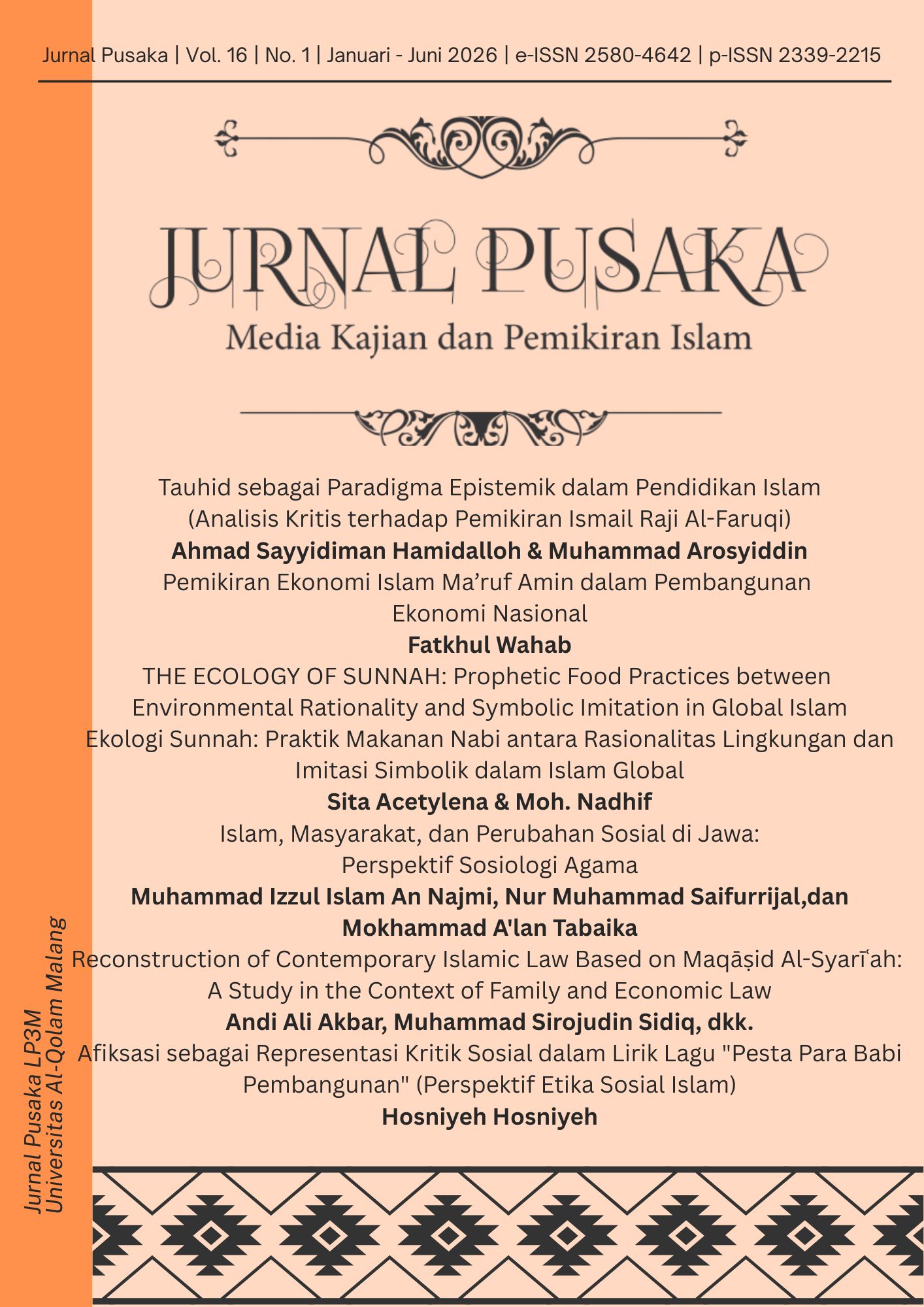
Islam, Masyarakat, dan Perubahan Sosial di Jawa:
Perspektif Sosiologi Agama
DOI:
https://doi.org/10.35897/ps.v16i1.2656Abstract
This article examines the relevance of the sociology of religion in understanding the dynamics of Muslim society in Java amid contemporary social transformation. The study employs a qualitative approach using a library research method by analyzing academic books, national and international journal articles, and other relevant scholarly sources concerning Javanese Islam, the sociology of religion, and social change. Data were analyzed through descriptive and interpretative techniques using the theoretical perspectives of Émile Durkheim, Max Weber, and Peter L. Berger to explain the reciprocal relationship between religion and society. The findings indicate that Islam in Java has developed through a continuous process of interaction between Islamic teachings and local cultural traditions, resulting in religious practices that are adaptive, moderate, and socially inclusive. Religion functions not only as a system of belief but also as a social institution that shapes norms, values, collective identity, and social solidarity. Furthermore, modernization, urbanization, globalization, and digital technological developments have transformed patterns of religious expression, authority, and community interaction without diminishing the social significance of religion. Religious institutions and organizations, particularly pesantren, Nahdlatul Ulama, and Muhammadiyah, continue to play strategic roles in strengthening social cohesion, promoting religious moderation, and fostering community empowerment. The study concludes that the sociology of religion provides a comprehensive analytical framework for understanding the interaction between Islam, local culture, and social transformation in Javanese Muslim society. This perspective demonstrates that religion remains a dynamic social force capable of adapting to changing social conditions while maintaining its essential role in preserving social integration and cultural continuity.
Key words: Sociology of Religion; Javanese; Islam; Social Change; Society
Downloads
Downloads
Published
How to Cite
Issue
Section
License
Copyright (c) 2026 JURNAL PUSAKA: Media Kajian dan Pemikiran Islam

This work is licensed under a Creative Commons Attribution 4.0 International License.